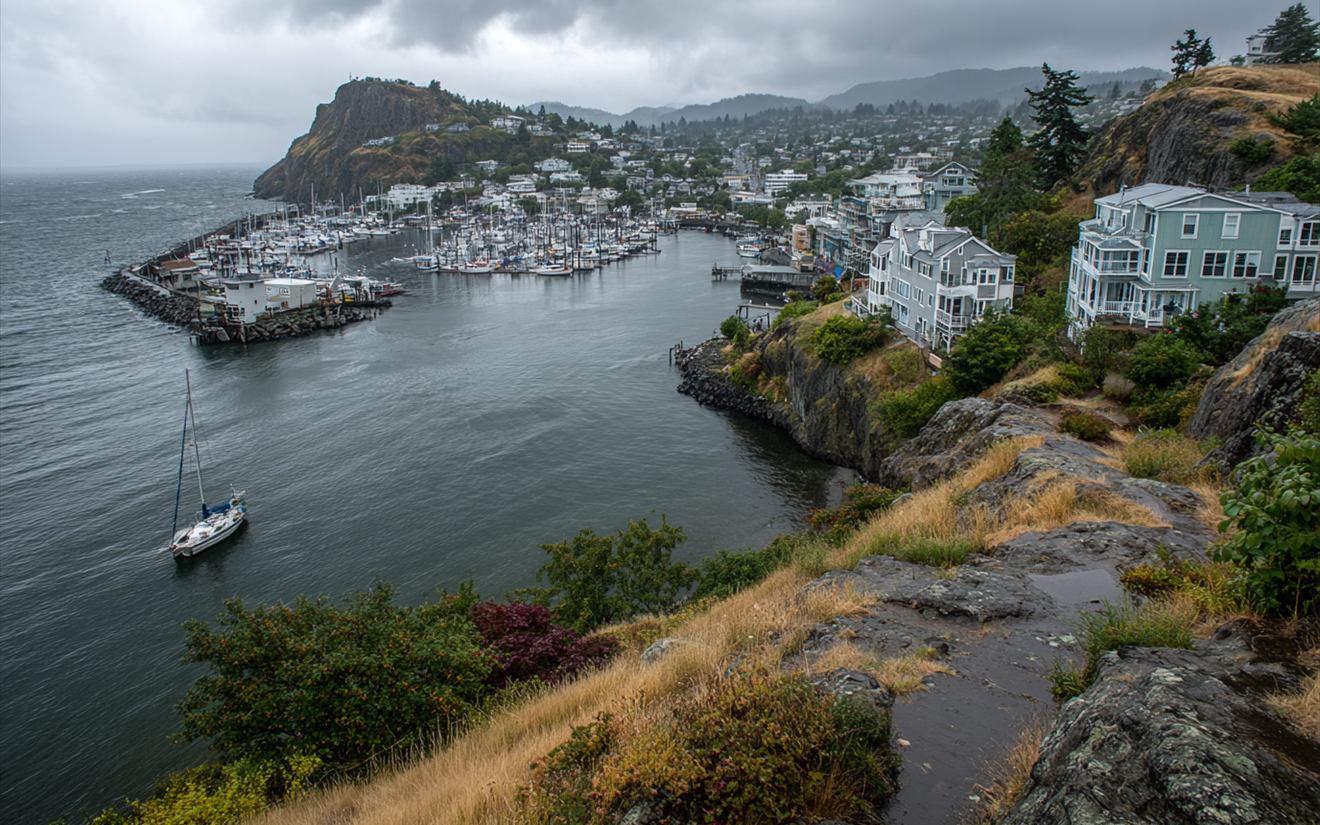
The west side of Everett and the shoreline toward Mukilteo are built on slopes and bluffs above the water. In Mukilteo, a railroad runs along the shore below tall bluffs cut by ravines and gulches, and parts of Everett's southwest side, including Boulevard Bluffs, sit on similar slopes above Port Gardner Bay. The views are the reason people buy there. The slope is the reason water damage on those lots looks different from water damage on flat ground.
How a Slope Moves Water
On flat ground, rain soaks straight down. On a slope, some soaks in and then moves sideways, downhill, through the soil. In a long wet season, a hillside carries a steady flow of water underground, moving toward whatever is in its way. A house set into the slope is in the way. The uphill side of the foundation meets that water first, and if the house has a basement, a daylight basement or a crawlspace dug into the hill, that's where water tends to show up.
This water often arrives later than the rain. It can take days to work through the soil, so a basement wall on the uphill side may get wet well after a storm, and stay wet during a dry day in the middle of a wet week.
What You See Inside
| Where | What it looks like |
|---|---|
| The uphill basement wall | A damp band along the bottom, or seepage through cracks |
| The uphill crawlspace corner | Standing water on the vapor barrier, wet insulation nearby |
| A daylight basement | The buried side wet while the open side stays dry |
| Floors near the uphill wall | Damp carpet edges, lifting flooring along that wall |
| Window wells on the uphill side | Wells that fill and spill past the window |
What Makes It Worse
- Downspouts that empty on the uphill side, adding roof water to the ground water already moving downhill.
- Paving or patios uphill that send surface water toward the house.
- Clogged drains around the foundation or in window wells.
- Long wet spells that keep the hillside saturated for weeks.
- Older foundations with more cracks and fewer drainage features.
Bigger Questions on Steep Slopes
On steep bluffs, ground water is also one of the things that affects slope stability. Snohomish County and the City of Everett both have information on geologic hazard areas, and work near a steep slope can need extra permits and studies. If you see new cracks in the ground, leaning trees, or soil movement near your house, contact the city or county. That's a different question from water damage, and it isn't something a restoration company decides.
What a Restoration Company Does
For water that has already come in, the work is the same as any below-grade water: pump out what's standing, remove wet materials that can't be dried, and dry the walls, floor and framing to readings. On a sloping lot, the company will look closely at the uphill side, because that's where the water is coming from and where it's likely to keep coming during wet weather. Drainage work outside the house is separate.
A Wet-Season Routine for Sloping Lots
- After the first long rain each fall, look at the uphill basement wall or crawlspace corner.
- Make sure downspouts on the uphill side carry water well away from the house.
- Clear window wells and any surface drains before winter.
- Photograph anything damp so you can compare year to year.
- If water starts coming in, move belongings away from the uphill wall and call.
Daylight Basements on a Slope
Many houses on Everett's slopes have daylight basements: one side buried in the hill, the other open at ground level with windows and a door. They're bright and useful, and they get wet in a predictable way. The buried side and the two side walls take the ground water; the open side usually stays dry. Finished rooms against the buried wall are the ones to watch. Water there often shows first at the bottom of the drywall or under carpet along that wall, well before anything appears in the middle of the room.
Questions
Why does my basement get wet on only one side?
Because ground water on a slope moves downhill and reaches the uphill side of the house first. The downhill side often stays dry.
Why does the water show up days after the rain?
It takes time to travel through the soil. On a slope, water keeps moving toward the house after the rain stops.
Is this the same as a landslide risk?
No. Water damage inside the house is about water getting in. Slope stability is a separate question for the city, the county or a geotechnical professional.
Around Everett
Sloping lots are common in Boulevard Bluffs, Mukilteo and Edmonds. Below-grade water is covered on basements and crawlspaces.
Washington DNR landslide information
Basements and the Water Table in the North End
Why basements leak in long wet spells and not single storms.

Everett's Rain Year: What 40 Inches Does to a House
A month-by-month look at the wet season and the dry one.