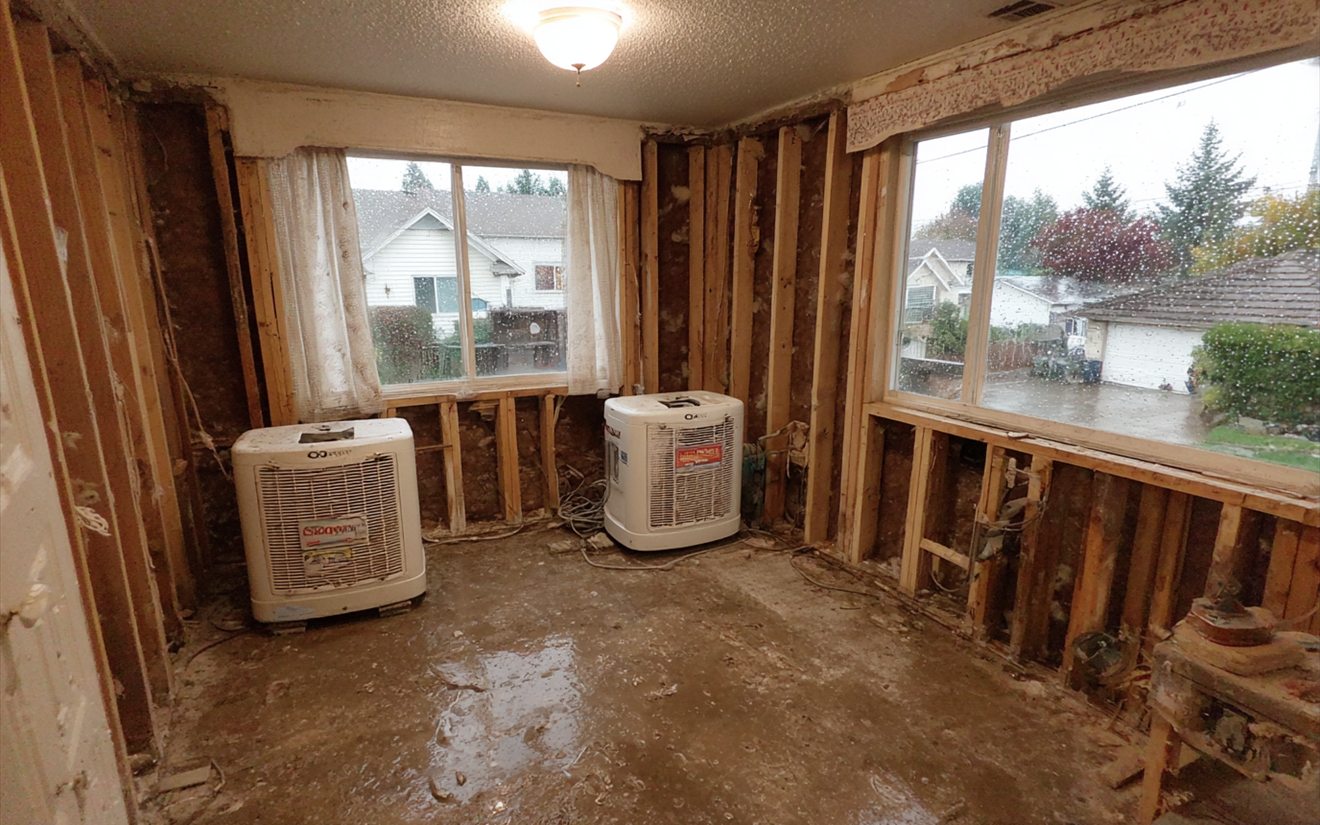
Water Damage Restoration in Everett, From First Visit to Last Repair
For an Everett owner or landlord, restoration is everything between the moment water gets in and the day the room looks normal again. The source gets stopped, the standing water comes out, the wet materials are dried until a meter backs it up, and whatever had to be cut out or thrown away gets rebuilt. Water restoration companies split that into an urgent first stage, mitigation, which keeps the damage from growing, and the longer finish that runs through the last coat of paint. In a wet climate the drying part matters most, because a house that's left damp stays damp for a long time.
Mitigation, Restoration and Repair in Plain Terms
- Mitigation is the urgent front end, done over the first few days: shutting off the water, pumping and extracting, getting belongings out of the way, pulling out ruined materials, and running drying equipment with a moisture check on every visit.
- Restoration is the whole arc, mitigation included, ending when the house is back the way it was.
- Repair is the rebuild at the end, once everything reads dry: drywall and texture, paint, trim and baseboards, flooring, cabinets.
- Remediation comes up on water jobs that involved dirty water, such as the river or street runoff. It means the cleaning and treatment that has to happen before those materials are dried or taken out.
What Water Restoration Companies Do First
- Cut off the source. For a pipe or an appliance, that means the main valve. For rain or ground water, it means figuring out the entry point.
- Map how far it went. Meters and an infrared camera trace the water under flooring, up the walls, into the next room and down into a lower unit.
- Extract before drying. Pumps and extraction wands take out the standing water first. Removing it as liquid is far quicker than evaporating it later.
- Take out what won't come back. Soaked pad, swollen particleboard, wet insulation, and drywall that drew water up high.
- Close up and dry. Dehumidifiers and air movers matched to the space, with the house shut so the equipment isn't fighting damp outside air.
- Measure on every visit. Each room's numbers get written down, and drying stops only when wet materials match the dry ones elsewhere.
- List the rebuild. A written account of what came out and what has to go back, for you and for the insurer.
Drying in a Wet Climate
In the wet months, the air outside in Everett is often close to saturated. Opening windows on a gray November day brings more moisture into the house, not less. That's why restoration drying is done with the house closed up, using dehumidifiers to pull water out of the air while air movers push dry air across wet surfaces. It's also why jobs here can take longer than the same job in a dry climate, especially when a basement or crawlspace is involved and the ground outside is still full. A company that keeps checking with meters, rather than going by how a room feels, is the one that gets it done. More: drying a house while it keeps raining.
What Makes One Job Bigger Than Another
Nobody can price a water job without seeing it. These are the things that decide how big it is:
- How far the water traveled. One room on a concrete floor is a small job; a bathroom leak that reached the kitchen ceiling and the basement isn't.
- What it soaked into. Tile dries; carpet pad, particleboard and insulation usually don't.
- How long it sat. A burst hose found in an hour is a different job from a slow leak behind a wall for a month.
- Where it came from. Clean water from a supply line versus river or street water that means more removal and cleaning.
- Below grade or not. Basements and crawlspaces take more equipment and more time, especially while the ground is wet.
- The repair afterward. Matching drywall texture, flooring and cabinets is often the largest part of the final bill.
Owners, Landlords and Who Signs the Work Order
On an owner-occupied house, the owner hires the company and approves the work. In a rental, it's normally the landlord or property manager, because they own the building and its insurance policy, even when the tenant found the water. In a condo, the owner handles their unit's interior, and the association handles common areas and building parts according to its documents. Before work starts, make sure the person signing is the person who can approve it. More: owner, landlord or tenant.
Belongings and Contents
Restoration covers what's in the house as well as the house itself. Furniture can be lifted off wet floors and dried, rugs and soft goods may be cleaned or discarded depending on the water, and documents and photos can sometimes be saved if they're dealt with quickly. Make a list as items are moved or thrown out, with photos, because that list is what the insurer works from. In a rental, the tenant's belongings are the tenant's to claim, usually on a renter's policy.
How Long Does Drying Take in an Everett House?
It depends on what got wet and where. A clean leak caught quickly on one floor can read dry in a few days. Water in a basement, under a hardwood floor, or inside an outside wall usually takes longer, and the damp season outside slows it further. The company keeps the equipment running until the readings say dry; nobody should promise a date before measuring.
Does a Restoration Company Fix the Leak Too?
Usually not the source itself. The roof, the window, the pipe or the foundation repair is separate work. The restoration company deals with the water and everything it damaged inside: extraction, drying, removal and rebuilding. Some jobs involve both, so ask the company to be clear about which parts it's doing.
Restoration Around Everett
Bay side
North end and river
South and central
South county
- MukilteoSouth county
- Mill CreekSouth county
- LynnwoodSouth county
- EdmondsSouth county
- Mountlake TerraceSouth county
- Martha LakeSouth county
Across the river
- MarysvilleAcross the river
- Lake StevensAcross the river
- SnohomishAcross the river
- MonroeAcross the river
Water still standing? See water removal and cleanup.