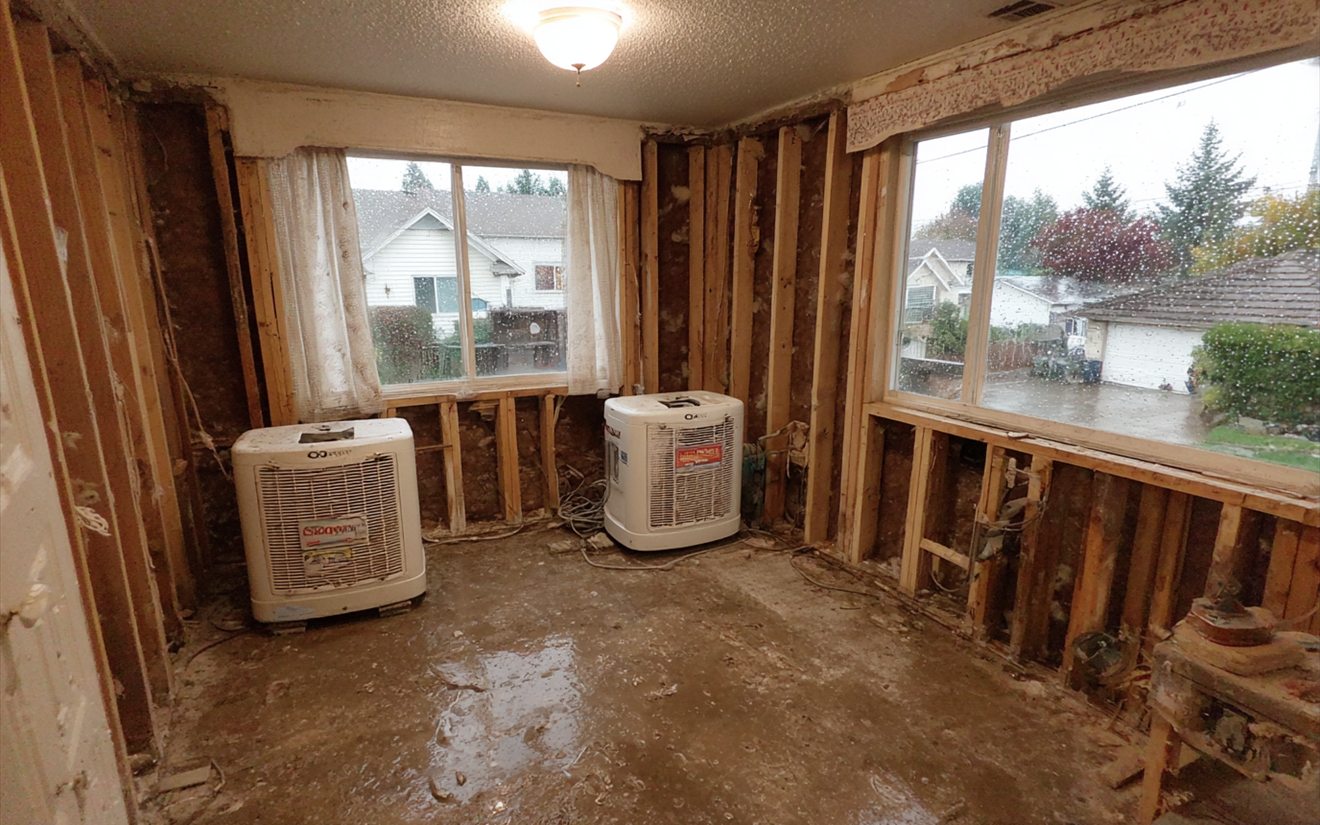
After water damage, the instinct is to open the windows and let the house air out. On a warm, dry day somewhere else, that might help a little. In Everett in November, it does the opposite. The outside air is often close to saturated, so opening up the house lets damp air in. Drying a wet house in the wet season works differently, and understanding why helps you know what to expect from the company doing it.
Why Damp Air Can't Dry Anything
Air can only take up so much water. When the outside air is already holding nearly all it can, as it often is on a gray, drizzly day, it has little room left to absorb moisture from wet drywall or floors. Bringing that air inside just adds to the moisture in the house. That's why restoration drying is done with the house closed up, using dehumidifiers to pull water out of the indoor air and air movers to push that drier air across wet surfaces.
How Professional Drying Works
- Remove what's standing. Every gallon pumped or extracted is a gallon that doesn't have to evaporate.
- Take out what won't dry. Soaked carpet pad, swollen particleboard and wet insulation come out.
- Open the wet spaces. Baseboards come off and drywall is cut where it's wet inside, so air can reach the cavity.
- Set the equipment. Dehumidifiers sized to the space and air movers aimed at the wet surfaces, with doors and windows closed.
- Control the area. Sometimes plastic is used to close off the wet area so the equipment works on a smaller space.
- Measure. Moisture readings in the wet materials and in dry ones elsewhere in the house, every visit.
- Finish by the numbers. Drying is done when the wet materials read the same as the dry ones.
Why It Can Take Longer Here
| Factor | Why it slows drying |
|---|---|
| Damp outside air | No help from opening the house |
| Basements and crawlspaces | Below-grade spaces sit against wet ground |
| Ground water still coming in | Drying can't finish until seepage stops |
| Cooler indoor temperatures | Water evaporates more slowly in cool air |
| Older houses | Plaster, old flooring layers and dense materials hold water |
| Hardwood and subfloors | Wood gives up water slowly and can warp if dried too fast |
None of this means drying can't be done. It means the equipment runs as long as it needs to, and the readings, not the calendar, decide when it's finished.
What You Can Do During Drying
- Keep doors and windows closed in the drying area unless the company tells you otherwise.
- Leave the equipment on. Turning it off overnight slows everything down.
- Keep the heat at a normal setting. Warmer indoor air helps.
- Don't move the equipment or block the airflow.
- Ask to see the readings. A good company will show you the numbers and explain them.
Signs It's Not Really Dry
- a musty smell that doesn't go away
- paint that bubbles or peels again after repainting
- flooring that cups or lifts after it's put back
- a stain that returns
- baseboards that swell again
Each of these usually means the materials were closed up before they were fully dry, which is why measuring matters.
Drying Different Materials
| Material | How it dries | What to expect |
|---|---|---|
| Drywall | Fairly quickly once opened at the bottom | Often a few days for a clean leak |
| Wood framing | Slower, from the inside out | Readings decide; may take longer than the drywall |
| Hardwood floors | Slowly; dried too fast, they crack or cup | Special mats or careful settings, sometimes a week or more |
| Concrete | Very slowly | A slab or basement floor often takes the longest |
| Insulation | Usually not dried | Wet batts and blown-in insulation are typically replaced |
Questions
How long does it take to dry a house after water damage?
It depends on what got wet and how. A small, clean leak might take a few days. A basement, a hardwood floor or a long-running leak takes longer, especially in the wet season.
Is the equipment loud?
Air movers and dehumidifiers make steady noise. Most people find it manageable, and it's temporary.
Why are the fans still running if the room feels dry?
Because the surface can feel dry while the inside of the wall, floor or framing is still wet. The readings show what touch can't.
Around Everett
Drying takes longest in crawlspaces like those under many Silver Lake and Martha Lake homes, and in South Everett apartment buildings, where more than one unit is involved. The full job is covered on restoration and mitigation.
Basements and the Water Table in the North End
Why basements leak in long wet spells and not single storms.
Owner, Landlord or Tenant: Who Calls About a Leak in Washington
Who does what when the leak is in a rental or a condo.