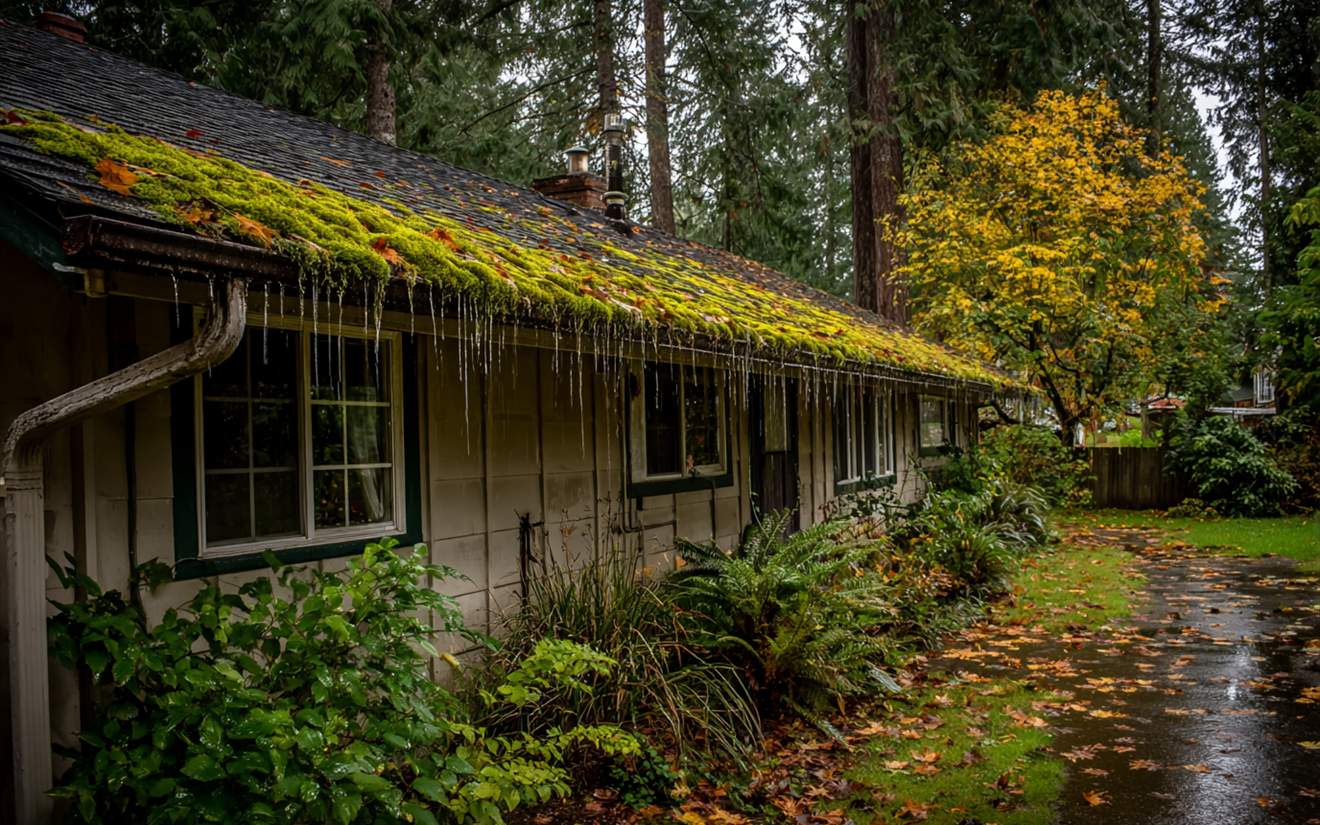
In much of the country, a roof leak means a storm. In Everett, it often means months. Rain here comes as long stretches of drizzle and showers rather than one big downpour, and roofs stay damp for days at a time. Moss loves that. Over years, moss, needles and debris hold water against the roof, lift shingle edges, and clog the paths water is supposed to follow. The leak that finally shows up on a bedroom ceiling in December is usually the result of that slow wear, not a single storm.
What Moss and Constant Damp Do
- Hold water against the roof. Moss acts like a sponge, keeping shingles wet long after the rain stops.
- Lift shingle edges. Moss growing under and between shingles can raise them, letting wind-driven rain underneath.
- Clog gutters and valleys. Debris and moss in valleys and gutters slow water down and can push it back under the roof edge.
- Wear the surface. Constant wetness speeds up the aging of shingles and the layers beneath.
None of this happens overnight. A roof can look fine from the street for years while it slowly loses its ability to shed water.
Where the Water Gets In
| Roof area | What goes wrong | The sign indoors |
|---|---|---|
| Roof valleys | Moss and debris dam the water | A stain near an inside corner of a top-floor room |
| Around chimneys | Flashing lifts or the sealant fails | A stain around the chimney, damp drywall nearby |
| Vents and pipes through the roof | Boots and sealant crack with age | A small stain near a bathroom or kitchen |
| Skylights | More flashing to fail | Water at the skylight well |
| Eaves | Clogged gutters overflow under the edge | A stain along an outside wall near the ceiling |
| Worn areas of shingles | The roof simply wears out | A stain below that area after long rains |
How the Water Reaches the Room
Water that gets past the roof covering wets the roof deck and runs along it or the rafters until it drips onto the attic insulation. Insulation absorbs it and holds it, so the ceiling below doesn't show a stain right away. Only when the insulation is soaked does water pass through to the drywall. That's why Everett ceiling stains often appear in the middle of the wet season, and why the wet area in the attic is usually bigger than the stain below.
The Inside Damage
Fixing the roof is a job for the roofing trade. The water already inside is a separate job:
- wet insulation removed and replaced
- ceiling drywall dried or, if it's soft or sagging, cut out and replaced
- wall cavities below checked and dried if water ran down
- once the readings say dry, the ceiling is sealed, retextured and repainted
Repairing only the roof leaves wet insulation and drywall behind. Repairing only the ceiling leaves the opening for the next rain. Both need doing, roof first.
Signs to Watch
- a stain on a top-floor ceiling that grows during long rains
- a damp smell in an upstairs room or closet
- water marks on the roof deck when you look in the attic with a flashlight
- gutters that overflow every storm
- thick moss on the roof, especially on north-facing or shaded sides
Gutters Matter More Here
On a roof that sheds water for months, gutters do a lot of work. When they're full of moss, needles and leaves, water backs up at the roof edge, spills over the front, and can run behind the gutter onto the fascia and into the top of the wall. That shows up inside as a stain along the top of an outside wall, or water running down inside the wall cavity. Cleaning gutters before the wet season, and again midwinter if there are trees nearby, is one of the cheapest ways to keep water out.
In a Rental
Roof and gutter upkeep belongs to the landlord in most rentals. Tenants can help by reporting a stain the first time it appears, with the date and the weather, rather than after it has grown. A stain reported early usually means a smaller drying job and less of the ceiling to replace.
Questions
Does moss on the roof always mean a leak?
No, but it means the roof stays wet longer and wears faster. It's a warning sign, especially on an older roof.
Why did the stain appear on a dry day?
Because the insulation above held water from earlier rain and released it slowly. Stains often show up after the rain has passed.
Can I just paint over a roof-leak stain?
Only after the roof is fixed and the ceiling and insulation are dry. Otherwise the stain returns.
Around Everett
Older roofs in Northwest Everett, View Ridge and Mountlake Terrace are the usual places for these leaks. Inside damage from rain is covered on rain getting in.

Everett's Rain Year: What 40 Inches Does to a House
A month-by-month look at the wet season and the dry one.

Condensation or a Leak? Wet Windows and Damp Walls in Winter
How to tell the two apart.